Old news archive
Latest news
23 APR 2010
Conservatives support Crossrail
 Angie hit back at another round of Labour smears, this time about the future of Crossrail in Ealing and Acton. Conservative volunteers fanned out across stations in the constituency to reassure the Conservative Party manifesto commitment to Crossrail. They handed out thousands of leaflets which quoted support for Crossrail from London Mayor Boris Johnson and Shadow Transport spokeswoman Theresa Villiers. Angie said, "Let me be clear, Conservatives are committed to Crossrail. Have labour got nothing positive to say to voters about why they should vote in another term of government? First they tried to frighten the elderly. Now it's the turn of commuters, who's next on their list?
20 APR 2010
More Grotspots!
Angie and her team of supporters donned their gardening gloves to spend a morning cleaning up rubbish around Ealing Common as part of her Grotspot programme. This was the first time they had turned their attention to the Common. Previous Grotspot targets have included messy corners in Walpole and Ealing Broadway, and overgrown alleyways. After collecting eight bags worth of rubbish Angie said, "good environmentalism begins at home. Getting people involved in keeping their neighbourhoods tidy is something which David Cameron highlighted in the launch of his ‘Big Society' agenda. It can make such a difference when everyone is prepared to lend a hand and do their bit for their local community."
19 APR 2010
Street stall - NO to Heathrow Expansion
Conservative volunteers from Ealing Central & Acton joined forces with others from across the boundary in Brentford and Isleworth at Turnham Green Station and Acton Green to voice their opposition to the third runway at Heathrow airport. They also had a petition with them and gathered hundreds of signatures. Angie took the opportunity to remind passers by that only a Conservative government will guarantee an end to further expansion of the airport. As she said, "the Liberal Democrats, supporting another term of Labour government in a coalition would be propping up a party who has pledged to give a green light to the third runway. Conservatives believe that Heathrow should be better, not bigger, and will stop any expansion plans from takeoff."
10 APR 2010
NHS Action Day Saturday 10 April
Angie joined local Conservative supporters at a street stall in Ealing Broadway to campaign against the threatened closure of the A&E departments at both Ealing and Central Middlesex hospitals. She launched a petition in protest and said afterwards "I was staggered by the number of people who rushed to sign the petition and express their concern about the closure plans. The NHS is a fantastic institution and the positive response we've received shows how important the services offered by these departments are to local people."
09 APR 2010
Sir George Young returns to Ealing
Angie welcomed Sir George Young, Shadow Leader of the House of Commons, back to Ealing last Friday afternoon. They were joined by Conservative Council Candidates and spent a successful hour canvassing houses around Haven Green. Afterwards Angie said, "It was great to welcome Sir George back again. He has a lot of friends here and had some good advice for me as the Candidate. It was great that he took time out of his busy schedule to come and help with my campaign here."
08 APR 2010
Sedra Nursing Home visit
Angie was given the opportunity to discuss matters of concern with the residents of the Sedra Nursing Home. Angie commented afterwards, "I found this meeting extremely useful and learnt a lot about the issues that are important to the elderly. What struck me most were the financial concerns of many. I was happy to reassure them that a Conservative Government would raise basic state pensions and restore the link to earnings while also ending the scandal of elderly people having to sell their home to pay for residential care. I offered a guarantee to residents that a Conservative Government would not abolish the Winter Fuel Allowance, cut free TV Licences, bus passes or pension credits."
08 APR 2010
Angie visits a local Mosque
Angie was delighted to meet the Muslim community and its leaders at the Acton Mosque. She was accompanied by Deputy Mayor and local London Assembly member Richard Barnes, and the Chairman of the Wycombe Islamic Mission, Zafar Iqbal. Angie was invited to address the congregation and responded to a number of questions and concerns. She said afterwards, "I very much enjoyed the visit and valued the opportunity to discuss many issues of importance. I was shocked to hear of the recent arson attack at the Mosque and I'm glad to be able to offer my help. I have taken this up with the local Council to ask for extra security measures to be put in place.'"
07 APR 2010
House meeting on Wesley Estate
Angie joined a group of residents on the Wesley Estate for tea with their two local Conservative Councillors, Councillor John Ross and Councillor Jim Randall. A number of concerns were raised and residents told her that their most pressing need was for a Community Centre to provide a focal point for the neighbourhood.
Angie said afterwards, "I do understand why the Wesley Estate would benefit from a Community Centre. Councillors John Ross, Jim Randall and I assured the gathering that this idea has our full support."
07 APR 2010
Michael Flanders Centre
Angie spent a morning at the Michael Flanders Centre meeting staff and a number of those attending for the day, including those from Age Concern. She was given a thorough tour of the facilities and took the opportunity to learn more about the important work they do. She said afterwards, "The Michael Flanders Day Care Centre is an invaluable local facility. I was greatly impressed with the high standards of care and range of activities available there."
22 MAR 2010
Watch out for the latest charity scam!
 Angie has been approached by a number of residents who are concerned that yet again a commercial company posing as a charity is asking people to leave out clothes, textiles and even donations. They are dropping leaflets through letterboxes which have been designed to look almost identical to The British Heart Foundation's material. Angie has now reported this to the police, to the local Trading Standards and The British Heart Foundation itself.
It would appear that the company officially ceased trading in March 2009, which would make the literature, which includes in tiny writing their commercial registration details at the bottom of the leaflet, illegal. Angie said, "The message from all those I have reported this to is very simple: Read the details carefully before leaving out anything that might go to the wrong people. We want charities to benefit from people's kindness, not be threatened by bogus operators, who are just trying to make money. "
Photo caption: The leaflet in question
18 MAR 2010
Angie visits Remploy in Acton
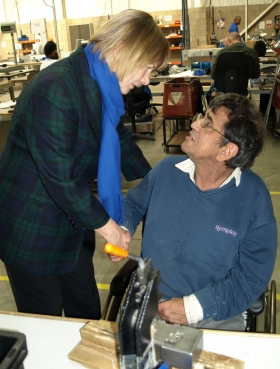 Angie was delighted to be contacted by one of Acton's local employers and invited to come and visit their factory in North Acton. Remploy specialises in providing employment for people with disabilities. Their Acton factory, with a staff of 41, produces a variety of products, many of which require the workers to have complex and intricate skills. What impressed Angie most was that a large percentage of the staff have worked there for many years, indicating that it is a well-run work place with a happy staff. After the visit Angie said, "I really enjoyed my visit to Remploy in Acton. What they are doing is really impressive and they are making a real contribution with the successful business they run there. They took a bit of a hit during the recession, but they are working hard to get back on track with plenty of ideas for new business to chase. Their management is clearly very innovative and I am confident they can continue to grow. What would really help them is picking up more contacts from local businesses and I will do everything I can to help to promote them. "
Photo caption: Angie with Remploy employee, Adrian Smith
16 MAR 2010
Scaremongering is no way to conduct a General Election
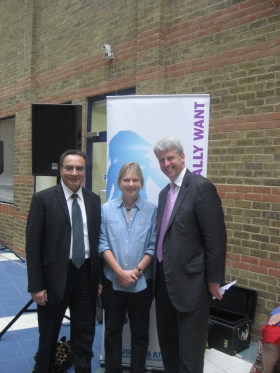 A local resident, made anxious about the future of cancer care by an email from the local Labour Parliamentary candidate, shared with Angie the contents for comment. She was outraged to read that Councillor Bassam Mahfouz has been scaremongering by accusing the Conservative Party of planning to scrap the target of a time limit of two weeks between cancer diagnosis and an appointment with a specialist. This serious misrepresentation needs to be nipped in the bud.
A Conservative Government will NOT stop cancer patients from seeing a specialist within two weeks. It is essential that cancer patients are seen quickly - and they will be under Conservative NHS reforms. But speed isn't all that matters. They also need top-quality treatments. For example, under Labour, many new drugs, which are widely available in other European countries, aren't available here. That's why the Conservatives said they would measure their performance on improving cancer survival rates rather than just looking at waiting times.
Angie said, "It is really depressing that, before the election campaign proper even starts, my Labour opponent is already using scare tactics to frighten voters rather than discussing the real issues.
"If anyone else gets one of these misleading emails from the Labour Party, please forward them to help@angiebray.org.uk and I will be happy to deal with them personally.
And for the record, in case the next email from Cllr Mahfouz attempts to frighten voters further by accusing Conservatives of planning to end free bus passes, the Winter Fuel Allowance and free TV Licences for the elderly, let me again state categorically that all of them are fully supported by the Conservative Party."
Photo caption: Angie with a local GP, Wafik Moustafa and Andrew Lansley MP, Shadow Health Minister
15 MAR 2010
A cleaner future for Horn Lane
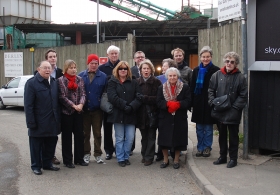 Angie stood shoulder to shoulder with local Acton residents and local Councillors in a demonstration outside Gowing & Pursey. She is supporting their campaign to reduce the pollution that blights the area around Horn Lane largely from the remaining industrial sites and the heavy goods vehicles accessing them. The residents believe it is time to rezone the area making it primarily a neighbourhood for offices and housing, rather than for industrial use as it is now.
Angie and local Councillors John Ross and Jim Randall and Council Candidate Tom Sweetman have already taken their case to the Leader of the Council's office to urge a rethink on the current status of the site.
Angie said, "The arrival of Crossrail at Acton Mainline station provides the perfect opportunity to make an important change to this area. These industrial sites are really a relic from Acton's past. Crossrail will bring huge extra demand for homes and offices with easy access to transport links in and out of central London. I'm sure the Council will want to consider this."
Photo caption: Angie along with local Acton residents and your local Councillors Jim Randall and John Ross
12 MAR 2010
Angie enters the debate over the future of Ealing Hospital's A&E;
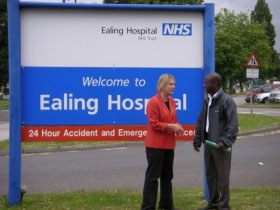 Angie spent a very informative morning at Ealing Hospital, being briefed by senior staff about the hospital and its future. In an in-depth briefing, Angie was told about the plans the hospital has for expanding the maternity services and their concerns about the rumours that the Accident & Emergency department may close due to the funding crisis in London.
Afterwards she said "It was important that I went to the hospital to meet the staff and hear first hand what is happening. Having learnt that the A&E department is dealing with up to 100,000 patients a year, I cannot see how it can be remotely possible to close the facility. Where on earth are these patients suppose to go? Obviously in time new patterns of patient care may be developed. But it would be extraordinary to close the A&E department before new services have been able to develop and time has been allowed for patients to get used to new ways of accessing healthcare.
The Conservative Party rejects the putative budget deficit that NHS London appears to be bandying around as a justification for six A&Es to be closed across North West London, including Ealing Hospital. Reports suggest that NHS London could be facing up to £5 billion* deficit but the Conservative Health Team does not accept this sum or how the figures stack up to reach it. A Conservative Government will carry out a review of NHS London and all the services it provides, but any decisions will be made on clinical needs rather than driven by bureaucrats."
Photo caption: Angie talking to an Ealing Hospital visitor
23 FEB 2010
Save Ealing Centre public meeting
Angie was invited to speak at a crowded meeting at the Town Hall organised by Save Ealing Centre (SEC) to discuss the future of Ealing Town Centre. She was part of a panel of Parliamentary Candidates and Councillors from the three main parties. The evening was chaired by BBC Correspondent, Stephen Sackur, who is also an Ealing resident.
She opened by telling the gathering that while she believes Ealing faces a major challenge, it also has huge opportunities. To Angie, the prospect of Crossrail, along with a new station at Ealing Broadway and the planned development of the adjacent Arcadia site - which is also awaiting new development plans - are opportunities that could bring enormous benefits to the centre of Ealing. She spoke about the working group that she has set up to provide a forum for local transport groups and SEC to discuss Ealing's needs with Network Rail, First Great Western and Transport for London who will share responsibility for the new Crossrail station. She was, though, surprised to hear Bassam Mafhouz suggest the imposition of a local Congestion Charge to pay for Ealing Broadway Station when 70% of Londoners had already voted against the western extension of the London Congestion Charge! She outlined her view that this would not help revive the centre of Ealing.
Angie agreed that better retail would be a key component in attracting more people to spend their money in Ealing. But, she also called for a better coordinated Arts programme that built upon the two week summer programme in Walpole Park and offered a winter programme that made use of the Town Hall's facilities and kept the Town Centre alive during the darker month of February.
She ended by talking about housing in Ealing. She said that she didn't accept the high housing figure for the borough in the London Plan and urged the Council to negotiate a more realistic number. But, she did suggest that Ealing will need to see some expansion, both because of Crossrail and because many local families want family members to stay in the area when they leave home. She said that blocks of single bedroom flats wouldn't be right for Ealing and that what was needed was family housing to help maintain a balanced community. She finished by saying that Ealing's green spaces must be protected and that, above all, local services must be expanded to meet the additional demand.
Afterwards Angie said "It was an excellent evening, well organised and briskly chaired by Stephen Sackur. I was delighted to be invited to take part and felt that the event provided a useful opportunity for Ealing residents to put forward their often very trenchant views on the future of the Town Centre which will affect us all."
16 FEB 2010
"Let's talk about Transport"
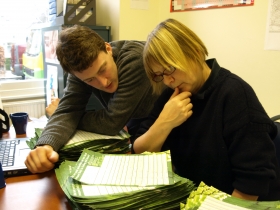 Angie has been overwhelmed by the massive response to her transport survey that was sent last October to 30,000 homes across Ealing and Acton. She asked detailed questions about local public transport, preferred modes of transport, safety on public transport, local road management and the plans for further expansion at Heathrow airport.
Two issues stand out clearly: 51% of those who responded support the Conservative pledge to scrap the Heathrow expansion, while 22% oppose it. On Crossrail, 69% agree with Angie's statement that it is vital for the future of Ealing, while only 7% disagree. Commenting on the scale of the responses Angie says, "I am really excited by the huge response to this survey. It just proves how important the issue of transport is locally and the information I have got back will really help to direct my transport campaigns."
Photo caption: Angie with volunteer, Hugo Sutherland, working on some of the transport survey responses
08 FEB 2010
Cuts to the Overground train services in Acton
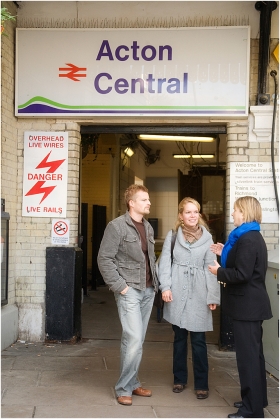 Angie was one of a large gathering in the room above the Rocket pub in Churchfield Road to discuss cuts in the Overland train service between Richmond and Stratford while the line is upgraded. This will affect the service which covers both Acton Central and South Acton stations. The plan is for no trains at all to run on Sundays on this part of the Northern Line. TFL and Network Rail representatives explained that the upgrade will improve the service eventually: there will be four-carriage trains running four times an hour, a more reliable service with improved stations. But passengers will have to live with restrictions on the line in the meantime. Those with travel cards and Oyster cards will get refunds for using alternative routes to their destinations, including the cost of going through Zone One. Some bus routes will also get refunded. Angie pointed out at the meeting that so far the only bus routes on which a refund has been arranged are the 228 and 220 buses running through Shepherds Bush, which is not much use for Acton residents. She has suggested they review this and consider extending the refund to the 266 bus route which runs through Acton towards Willesden Junction. TFL has promised to consider this.
Photo caption: Angie getting some feedback from Acton Central Station users
05 FEB 2010
Angie goes to see Twyford High School production of 'Oliver!'
Angie enjoyed a night out taking in "Oliver!" the musical at Twyford High School and was bowled over by the talent on display there. The school ran the show for four nights and each one was a sell-out. On the night she was there, Benjamin Schumm played Oliver, Melanie Philips was Nancy, Jamie Naylor a very scarey Bill Sykes and Adam Rust almost stole the show as Fagin. Angie said afterwards, "The whole cast was brilliant, as was the orchestra. I thoroughly enjoyed the evening. 'Oliver!' is one of my favourite musicals and I was incredibly impressed by the quality of the production. I am already hoping I get invited to the next one!"
27 JAN 2010
Angie pays tribute to those who lost their lives in the Holocaust
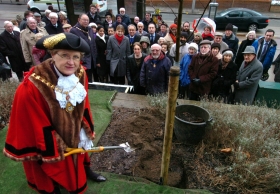 On 27th January Angie joined Mayor of Ealing, Councillor Barbara Yerolemou, Leader of Ealing Council, Councillor Jason Stacey and other local Councillors at a tree planting ceremony outside Ealing Town Hall to mark Holocaust Memorial Day. On the 65th anniversary of the liberation of Auschwitz-Birkenau, Councillor Stacey spoke to those gathered and called the new tree a symbol of renewal. Recalling the terrible murder of millions of innocent Jews, he outlined the importance of learning from history and invited everyone to take their turn in helping to plant the tree.
Afterwards Angie commented, "I was so pleased I was there to pay my respects to those who lost their lives and also to the survivors, who still bear the scars of those appalling events."
Photo caption: Ealing Mayor, Councillor Barbara Yerolemou, planting the tree outside Perceval House
Photo courtesy of Ealing Gazette
14 DEC 2009
Acton residents press for "Green Corridor" on A40
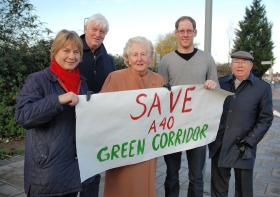 Angie joined East Acton Conservative Councillors, John Ross and Jim Randall and Conservative Council Candidate for East Acton, Kieran Mullan, on a demonstration organised by Acton residents on the A40. They were launching a petition and protesting against the continuing block on developing a "Green Corridor" between residential housing and the busy Western Avenue.
Some years back Transport for London (TfL) compulsorily purchased housing on the road in order to knock it down to allow the road to be widened. The project was then cancelled but TfL still hopes to sell the land onto developers. Residents, however, believe the space should turn into a mini green belt, a "Green Corridor", to help reduce the noise and pollution generated by A40 traffic. Angie said, "This has been dragging on for some time and I think it is unforgivable of TfL to deny local residents the opportunity to get some relief from the A40 traffic pollution. As I understand it, Ealing Council want to help but cannot do so while TfL continues to hold on the land in question. I hope that this campaign will eventually be taken to City Hall where it will be possible to alert the Mayor, Boris Johnson, to the problems being caused by TfL of which he is Chairman."
Photo caption: Angie with East Acton Councillors, Jim Randall and John Ross, Council Candidate Kieran Mullan and East Acton resident
08 DEC 2009
Twyford Abbey redevelopment
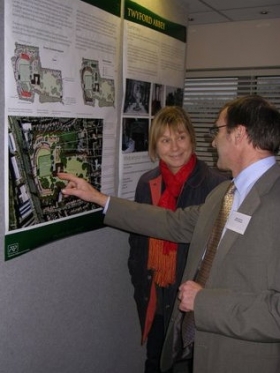
There are new proposals to develop the Twyford Abbey site in West Twyford. Angie went along to the one-day exhibition to discuss them with the architect, Nigel Butcher. She said afterwards that they are interesting plans with the potential to save the crumbling Twyford Abbey building.
However, as ever with these developments, her concerns lie chiefly around the issues of over-stretching of local public services
"West Twyford residents lost their nearby GP surgery when it was closed at the Central Middlesex Hospital back in 2007 and there is still no replacement. The new development would bring in more residents who would also need a local GP as well as school places for their children and other services. The Council, as well as other local service providers, will need to consider this carefully when the application is put before them."
Photo caption: Angie with Nigel Butcher, the architect for the development
08 DEC 2009
Rejection of Arcadia redevelopment plans
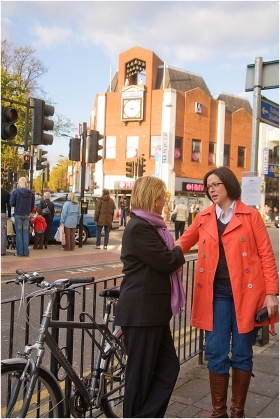 Commenting on the news that Glenkerrin has failed to get the go-ahead for its plans in central Ealing, Angie said, "Now that the Glenkerrin proposals for the Arcadia site have been turned down, it gives us all more time to consider what would benefit us most in that location. It is very clear that Ealing town centre is in much need of regeneration if it is to continue as a viable and attractive place for both shoppers and visitors alike.
What we now need are plans to give us that boost, but in a way that works with the character of Ealing. We must hope that we don't have to wait too long though as the last thing we need is for the site to be neglected, as that could leave a mess in the middle of the town centre."
Photo caption: Angie discussing the Arcadia development with an Ealing resident
18 NOV 2009
Remembrance Sunday Service in Ealing
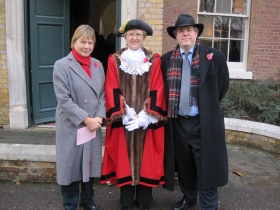
Angie and her partner Nigel attended the annual Remembrance Sunday service outside Pitzhanger Manor.
Angie commented, "I was delighted to attend the service, especially as I recently had the opportunity to meet the Royal British Legion at the Conservative Conference in Manchester. I was then presented with a copy of the Legion's manifesto for the next General Election. I think it is very important for the next Government to heed the calls made in the Royal British Legion's manifesto, especially with regard to tackling poverty among veterans and widows and providing far better NHS support to those injured while on service. Whilst we are struggling to get through a recession, we must never forget the sacrifice made by our soldiers and treat them with the respect they deserve. "
Photo caption: Angie with Mayor of Ealing, Councillor Barbara Yerolemou and Dr Charles Tannock MEP at the Sunday Remembrance Service
15 NOV 2009
Our young volunteers
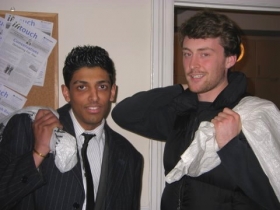
Ealing & Acton Conservatives are delighted to have two young volunteers, Sanjiv Walia and Hugo Sutherland, who are giving up their time to come and help in our busy constituency office. Here is what they say:
Hugo says, "Volunteering in the Ealing and Acton office has been a great experience. It has certainly opened my eyes to the realities of political campaigning and shown me just how hard everyone has to continue to work to ensure that the Party gains this important new seat. As a local resident myself I'm delighted to be helping a Candidate who really understands the people of our constituency and who has taken such a proactive and positive approach to addressing our problems. Having witnessed first-hand her energy in promoting practical solutions to our key issues of transport, crime and the regeneration of our dated town centres, I'm convinced that Angie is by far the best person to be representing us in Westminster."
Sanjiv says, "I'm proud to be part of the Ealing Conservative campaign. I'm giving up my time to help make this campaign successful because I believe Angie Bray can make this constituency a beautiful place to live in"
Photo caption: Sanjiv and Hugo on their way to the Post Office
04 NOV 2009
The Lido Junction - a pedestrians' nightmare
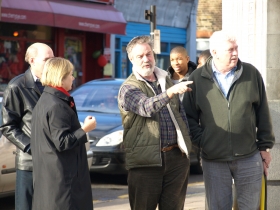 Anyone who has attempted to cross the street at the Lido / Uxbridge Road junction will know how difficult it is to get across. With no provision in place to stop the flow of traffic for pedestrians it is extremely dangerous, especially for the elderly or those crossing with young children. This is such a big issue for the Lido Junction Project Group (a body formed from the Five Roads Forum, the Kingsdowne Residents Association and West Ealing Neighbours) that they approached Angie with a view to briefing her on their ideas for improving pedestrian safety at this dangerous junction.
David Highton, Erich Leach (West Ealing Neighbours), Arthur Breens (Kingsdowne RA) and Lisa Hall (Five Roads Forum) took Angie to The Lido to demonstrate how the lack of traffic lights for pedestrians causes a problem for people crossing Drayton Green Road or Northfields Avenue.
The group also highlighted the heavy congestion on Drayton Green Road. Angie agreed with the points made and briefed TfL, who are responsible for the traffic lights at the junction.
She said, "We are organising a follow up meeting with Richard Barnes AM, GLA member for Ealing & Hillingdon and Councillor David Millican, Cabinet Member for Regeneration and Transport. We will then discuss in more detail what can be done to improve the safety of pedestrians crossing at this junction without affecting the flow of traffic on the Uxbridge Road. By then we should also have some more information on the TfL funding for the South - North ‘Corridor', which includes Northfields Avenue, Drayton Green Road and Argyle Road. At the moment this junction is an accident waiting to happen and something must be done to prevent that!"
Photo caption: Angie with Eric Leach, David Highton and Arthur Breens discussing the Lido Junction safety issues
02 NOV 2009
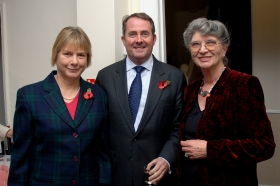
Dr Liam Fox MP visits Ealing
Shadow Defence Secretary, Dr. Liam Fox, joined Angie and members from Ealing and Acton Conservative Association at a reception in Ealing. During the evening he spoke of the difficulties faced by our troops in Afghanistan and underlined the importance of the dangerous work they are doing there.
He encouraged us to remember that it is crucial we achieve our key aim there: to stabilise the country and to ensure that it can no longer act as a base for terrorist training camps. He also warned that a further danger if we pulled our troops out too early would be that a Taliban- controlled Afghanistan would be able to destabilise Pakistan, whose own nuclear arsenal could endanger us all if it fell into the wrong hands.
Photo caption: Angie with Dr Liam Fox MP and Association Chairman, Mrs Norma Haythorn
24 OCT 2009
Tackling 'grot spots' continues
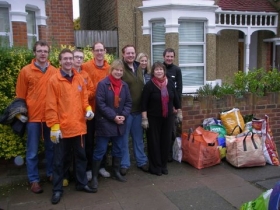 Angie and her Social Action Team have been out to tackle another grot spot. This time they joined Walpole residents to clean up an alleyway just off Adelaide Road in West Ealing. The team got their hands dirty cutting back brambles, weeds and undergrowth.
Angie said afterwards, "We were alerted to the grot spot by a local resident whose garden backs onto this alleyway. She organised a few neighbours to give us a hand and once we got together it took us no time to clear it! I was really pleased that we got to work with the local residents, which gave me an opportunity to meet them and have a chat.".
If you are aware of any area that could benefit from a clear up, please contact the Grot Spot Team on 020 8810 0579.
Photo caption: Angie with Conservative Future Team and Walpole residents, Barbara, Madine and Peter
10 OCT 2009
Reporting back from Conference - great news about Heathrow
Whilst the Conservative Party Conference was a slightly sombre occasion, the messages were honest and realistic. The best news for residents in Ealing and Acton must be that as result of a pledge to make Conservative opposition to further Heathrow expansion a manifesto commitment, BAA have now announced they will not seek planning permission for a third runway until after the General Election. This means a Conservative win at the election spells an end to this blight hanging over West London.
George Osborne's speech described some of the tough measures required to get Britain back on track, none of which would have been necessary but for the gross mishandling of the economy under Gordon Brown's administration, but it was not all doom and gloom as he announced:
* The link will be restored between state pensions and earnings
* A payment of £8,000 at the age of 65 will pay for residential care for the elderly, without forcing them to sell off all their assets as part of a means test to pay for it
* The occupational allowance for our service men and women will be doubled
* There will be many more further education and apprenticeship training places for young people
* Parents and teachers will be given the powers and the means to set up new smaller schools to set new standards for children and young people in education
* New tax measures to help support married couples and their families
David Cameron talked about how we will win through in the end and make Britain a great country again. A country where communities have taken back control, where families can watch their children grow and prosper in safety and with good opportunities ahead of them, and a country where we can start living more fulfilled lives by taking back the responsibility from the state.
I came away from the Conference in a determined mood, determined to continue going round meeting as many Ealing and Acton residents as possible, listening to ideas and helping to sort problems. I know the message is a difficult one but I believe that most people prefer to be treated as grown-ups, ready to understand what has to be done to get us out of the mess we are in. And I believe that there is a better future for us if we work towards it - and hopefully, a future without the extra noise and pollution from an expanded Heathrow."
02 OCT 2009
Boris meets Ealing Police and inspects Ealing Broadway station
Angie, along with Council Leader Jason Stacey, invited Mayor of London, Boris Johnson, to visit Ealing. They were keen to introduce him to some of Ealing's Safer Neighbourhood Team officers and PCSOs. Boris was also introduced to Polish police officers who are spending 3 months secondment in the borough to help work amongst the Polish community. Angie and Jason raised the important issue of insufficient number of police officers in the borough. They reminded Boris that Ealing suffers a shortage of funding for police officers in relation to the size of its population. The Mayor said that the whole situation is currently being reviewed.
Boris, Angie and transport issues
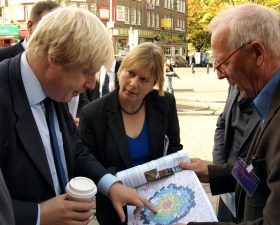
Angie and Jason also wanted to show the Mayor around Ealing Broadway station in order to impress on him the vital importance of ensuring that Ealing Broadway station is a top priority for upgrade when the Crossrail project starts. Boris was introduced by Angie to members of the Ealing Cycling Campaign, who have asked for his support in improving cycle parking facilities. He also agreed, after being shown the cramped ticket hall, to review TfL's refusal to reopen the old District Line entrance to the station, which would alleviate overcrowding and provide extra access points.
Both Angie and Jason were pleased that they had the opportunity to raise some important issues during a busy morning as they showed the Mayor around Ealing.
Photo caption: Boris with Angie and Ealing Cycling Campaign representative, Peter Mynors, discuss some of the issues faced by cyclists
01 OCT 2009
Angie at the Local Development Framework meeting in Acton
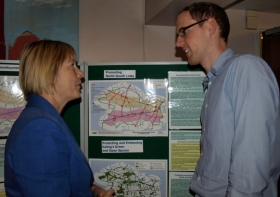
Angie attended the first consultation meeting, held in St. Mary's Church, to discuss the Local Development Framework plan for Acton. It was a lively gathering and Angie took part in one of the (round table) groups to talk through the right vision for the future planning of the area. The group touched on a number of key issues, including the importance of having a sustainable infrastructure to support new housing developments and also maintaining the character of the area. Everyone at the meeting agreed it was vital to preserve a proper sense of community.
The gathering also pointed out the need for having better north - south transport links to try and take some of the pressure off the Uxbridge Road and the A40, which carry the burden of development plans. Angie said afterwards "This was a really useful, as well as enjoyable, evening."
Photo: Angie with Council Candidate for East Acton, Kieran Mullan
30 SEP 2009
An end to noisy tannoy announcements?
If you live near an overground tube station, you will probably agree that the tannoy announcements can sometimes be rather disruptive. That is why Angie started a London wide campaign against intrusive tannoy noise from London Underground stations situated above ground. She produced a report for the London Assembly Environment Committee that made a series of recommendations to help TfL and local residents come to an agreement about acceptable noise levels.
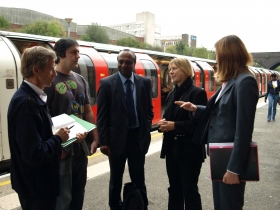
After receiving a complaint from a resident who had been seriously disturbed by loud tannoy announcements at North Acton tube station, Angie raised the issue with Ealing Council Officers and TfL. At a recent meeting with TfL representatives, a Council Officer and the resident, she was told that the volume of live and pre-recorded announcements has now been limited. The reduced sound pressure levels should now prevent any future noise disturbance. Angie was also promised that TfL will look into the noise problem caused by the overnight engineering works. She commented, "I was appalled that TfL had been ignoring this issue for so long, but we have finally managed to get all the right people to focus on the problem together and the residents are now enjoying a quieter life which, we hope, will last. I will also continue the pressure on TfL to tackle the noisy maintenance works that take place through the night."
Photo caption: Angie at North Acton station with Cyril Pennington(Ealing Council Officer), Kevin Cronin (North Acton resident) and two TfL representatives, Marian Kelly (Environmental Manager) and Naran Gorasia (Assistant Communications Manager)
19 SEP 2009
A new school for Jordon
Angie and Karim Sacoor, Council Candidate for Ealing Common, joined Kevin and Karen Bithell with their son Jordon to celebrate their son's first day at his new school. Angie and Karim had helped Kevin and Karen to get Jordon into their choice of school which specializes in children with special needs. Angie was delighted to meet Jordon and his parents and to learn that he is already making good progress at school, making good friends and enjoying his time there.
Photo caption: Kevin Bithell, Karim Sacoor, Angie, Jordon and Karen Bithell
16 JUL 2009
An update on transport news for Ealing & Acton
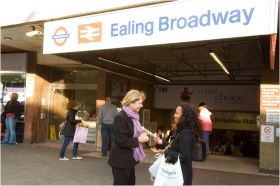 Angie's local transport group gathered for one of their regular meetings, organised in partnership with Network Rail, to discuss the latest news on transport issues concerning Ealing Broadway and Acton Mainline stations. They were presented with the latest plans from the Crossrail team, which seem to confirm that work will start at Ealing Broadway station in early 2013. Proposals for the station include much-needed escalators and lifts to and from the platforms.
First Great Western (FGW) also confirmed they have maintained their reliability percentages and remain hopeful that when the Department for Transport provide extra train carriages, they will be able to increase the train services at Acton Mainline station from two per hour to four.
There was one disappointment though. The installation of a cycle ramp on the staircases to the platforms at Ealing Broadway station has been ruled out by a Health and Safety report. However, FGW have agreed to consider the possibility of providing a system whereby passengers with heavy objects can summon assistance from staff to get up and down the stairs. They have also promised to look again at identifying space for extra cycle parking at Ealing Broadway station.
After the meeting Angie said "I do recognise that progress on many issues remains frustratingly slow. These meetings though provide local stakeholders with an opportunity to swap information and ideas with our transport providers in a very focused forum. We will continue to work with the Crossrail team to ensure that Ealing gets the best possible facilities from the station upgrades. We will also maintain pressure to get the small but important improvements like better cycle parking provision."
Photo caption: Angie talking to a resident about her views on Ealing Broadway station improvements
Content composed with the free online HTML editor toolkit. Please subscribe for a membership to stop adding links to the edited documents.
Search this site
Who runs Britain? Your vote will decide
Voters in this neighbourhood will determine who forms the next Government. This area is now a key marginal seat that the Conservatives must win to form a Government. Your vote will directly decide if Gordon Brown or David Cameron is the next PM.
 Back to Association